


Tipsy Chat: Live Your Story
krachdev
Tipsy Chat: Live Your Story is an entertainment app built around AI stories and role-playing, but its appeal is less about winning and more about seeing where a conversation can lead. I found it most enjoyable when I treated each exchange as an improvised scene rather than a traditional game with a clear objective. The experience invites you to chat, make choices, and shape a personal narrative at your own pace.
That makes it an easy app to open when I want something lighter than a full game and more interactive than simply watching a show. It is free to install, although optional purchases range from $1.49 to $649.99 per item, so I would approach the payment side carefully. The mature 17+ rating also matters: this is not an app I would casually hand to a younger user.
How the AI story experience feels in everyday use
The central idea is simple: you enter a conversational world and take part in it directly. Instead of following a fixed script from beginning to end, I could respond in my own words and see the story develop around that choice. That freedom is the main reason to try it. It feels closer to collaborative improvisation than to reading a digital novel.
In practice, I found the best sessions happened when I gave the conversation a clear direction. A short, vague reply can keep things moving, but a specific answer gives the scene more to work with. If I wanted a tense exchange, I made the character’s intention obvious. If I wanted something playful, I leaned into that tone rather than waiting for the app to create all the momentum by itself.
This is an important distinction for anyone expecting a conventional role-playing game. You are not simply selecting a character, collecting equipment, and following a map. The pleasure comes from dialogue, atmosphere, and the feeling that your wording can influence the next moment. People who enjoy interactive fiction, character chats, or spontaneous storytelling will understand the appeal quickly.
Related News

Why WhatsApp Messenger Still Makes Everyday Communication Feel Easy

Jurassic World: The Game Is the Better Dino Tycoon for Strategic Players

Threads in Real Life: Who Should Join, Lurk, or Leave

How SHEIN Turned Shopping Into an Endless Content Feed

How to Make Fortnite Feel Smarter on Mobile

Should You Switch to Microsoft Outlook on Mobile?
I also liked that the format suits short visits. A quick conversation during a commute or before bed can feel complete enough without requiring a long uninterrupted play session. At the same time, the open-ended structure means I could return when I had more time and continue exploring a different tone. That flexibility gives it a useful place between casual entertainment and a more involved role-playing experience.
Why the conversational format is the strongest feature
The biggest strength is the low barrier to participation. I did not need to learn a complicated control scheme or memorize a large set of rules before enjoying the app. The important skill is simply knowing what kind of scene I want and expressing it clearly. That makes the experience approachable, while still leaving room for creative users to experiment.
There is also a personal quality to typing a response instead of tapping through a small set of prepared choices. A menu can offer polished branches, but it can also make the player feel like an observer selecting from a script. Here, the act of writing becomes part of the role-playing. Even a simple decision can feel more meaningful when it is phrased in my own voice.
Gallery
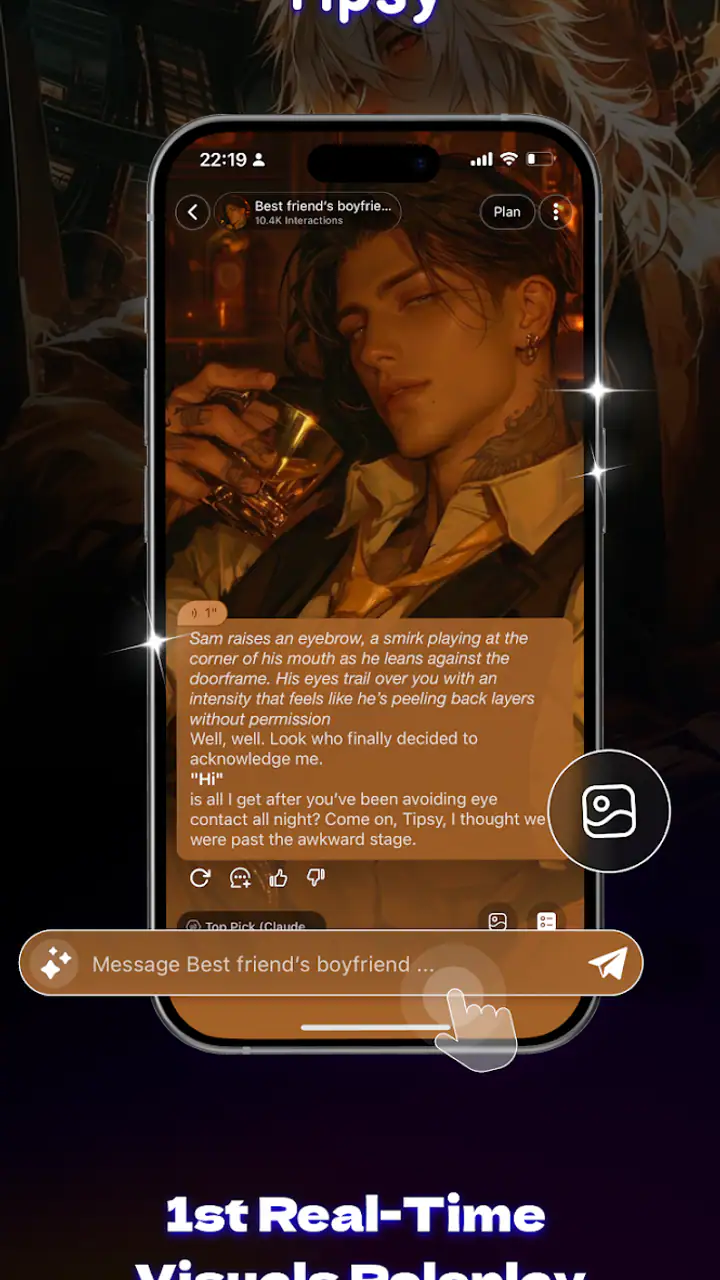
One useful habit is to treat each conversation like a writing prompt. I found better results when I established the mood early, kept my character’s personality consistent, and introduced one detail at a time. For example, rather than changing the entire direction in one message, I could reveal a hidden motive, ask a pointed question, or challenge the other character’s assumption. This created a more coherent rhythm than sending random responses.
Another practical tip is to use the app when I want to test an idea quickly. I could explore a character concept, rehearse a difficult conversation in fictional form, or see how a particular personality might react under pressure. It is not a replacement for real advice or a structured writing tool, but it can be a surprisingly convenient way to turn a vague idea into an active scene.
The app’s popularity suggests that this format has found an audience. It has passed one million installs, carries an average rating of 4.2 from around 33 thousand ratings, and has about 1.5 thousand written reviews. Those figures do not guarantee that every conversation will work for every person, but they do indicate that the concept is resonating beyond a tiny group of early experimenters.
Where it fits among entertainment alternatives
Compared with a streaming series, this is much more participatory. A show gives me stronger visual direction, professional pacing, and a finished story, while Tipsy Chat gives me control and unpredictability. If I want to relax without making decisions, a series is the better choice. If I want to influence the tone and participate in the scene, this app has the advantage.
Compared with a conventional role-playing game, the experience is lighter and more immediate. Traditional games usually offer deeper systems, visual worlds, progression, and carefully designed objectives. This app is easier to pick up, but it cannot provide the same sense of exploration or mechanical depth. I would choose a full RPG when I want a long-term challenge; I would choose this when the conversation itself is the entertainment.
It also differs from ordinary chat apps because the purpose is fictional interaction rather than keeping up with real people. That separation can be relaxing, especially when I want a social-feeling experience without the obligations of a real conversation. At the same time, anyone looking for genuine friendship, reliable human feedback, or meaningful real-world support should use a different kind of service.
The comparison with interactive fiction is probably the closest. The difference is that traditional interactive fiction often has carefully authored paths, while AI-driven conversations can feel more spontaneous. That spontaneity is exciting, but it also means the quality may be less even. A scripted story can deliver a precise emotional arc; an AI exchange may surprise me in a good way or drift away from the tone I wanted.
The limitation that affects long sessions
The same openness that makes the app interesting can also make it inconsistent. A conversation may begin with a strong premise and then lose focus if the replies become too broad or the scene changes direction too quickly. I sometimes had to guide the exchange back toward the original idea. Users who want polished, tightly edited storytelling may find that extra steering tiring.
This is not necessarily a flaw for everyone. Improvisation naturally includes detours, and some players will enjoy discovering unexpected turns. Still, it is a meaningful trade-off. The app gives me more freedom than a fixed script, but it also asks me to contribute more effort. The best experience is not completely passive; I have to help maintain the character, mood, and purpose of the conversation.
There is another point to consider with the mature 17+ rating. I would not assume that every scenario is suitable for a family setting, even if a particular conversation starts innocently. Adults should be comfortable with the app’s intended audience before installing it, and parents should not treat the age label as a minor detail. It is part of deciding whether this entertainment format belongs on a shared device.
The purchase structure deserves equally careful attention. The app itself is free, which makes trying it straightforward, but the optional items can reach $649.99. That is a very broad range, and I would recommend checking every purchase screen before confirming anything. On a device used by several people, purchase restrictions are especially sensible. The free entry point is appealing, but it should not be confused with unlimited access to every possible option.
I also think the app is better for users who enjoy typing than for people who want a purely visual experience. The conversation is the main activity, so someone expecting animation-heavy entertainment may feel that the format is too text-led. In that case, a story-driven game or video service would probably offer a more satisfying evening.
Small techniques that make the experience better
My first recommendation is to begin with a compact premise. Give the conversation a setting, a relationship, and an immediate problem instead of asking for a completely open story. That creates a useful frame without removing freedom. Once the exchange has momentum, I can widen the scene naturally.
Second, I would avoid treating every reply as a command. Describing a reaction, hesitation, or private motive often gives the role-playing more texture than issuing a blunt instruction. This is one of the less obvious ways to get more from the app: write as though you are participating in a scene, not filling out a form.
Third, I found it helpful to decide what I wanted from a session before starting. A ten-minute comic exchange needs a different approach from a slow dramatic scene. Without that intention, the conversation can become directionless. With it, even a brief visit can feel like a complete piece of entertainment.
A fourth tip is to change one variable at a time when exploring an idea. If I alter the setting, personality, conflict, and tone simultaneously, it becomes difficult to tell what produced an interesting response. Keeping most elements stable makes the experiment more useful, particularly for writers or role-players testing a character.
Finally, I would not judge the entire app by one awkward exchange. AI storytelling can vary from scene to scene, and a weak opening may improve when I clarify the goal. However, I also would not spend a long time forcing a conversation that is clearly going nowhere. The format works best when I am willing to redirect it or start fresh rather than expecting every thread to become memorable.
Who should install it, and who should skip it
I would recommend it to adults who enjoy interactive fiction, character-driven role-playing, and casual creative prompts. It is especially suitable for someone who wants entertainment that responds to personal input but does not require the commitment of a large game. Writers may also appreciate it as a brainstorming companion, provided they treat the output as raw material rather than finished prose.
It can work well in an everyday situation where I have a short break and want something more engaging than scrolling. For example, after finishing work, I might open a new scenario, set a light mystery in motion, and spend a few minutes testing how the characters respond to a suspicious clue. I can stop when the scene reaches a natural pause instead of worrying about losing progress in a long campaign.
I would skip it if I want dependable factual answers, structured personal guidance, or real human conversation. I would also choose a conventional story game if progression systems and visual exploration are the main reasons I play. The app’s strength is imaginative exchange, not simulation, competitive play, or carefully controlled narrative design.
People who dislike unpredictable AI responses may also become frustrated. The experience asks for patience and a willingness to revise the direction. If that sounds like work rather than fun, a scripted interactive novel will likely be a better fit. Likewise, users who are uncomfortable with mature entertainment should pay attention to the 17+ rating before trying it.
Device details and practical expectations
The Android release comes from krachdev and requires Android 7.0 or later. The current version is 1.4.5, so users on older devices should check compatibility before planning to use it. Since it is categorized as entertainment rather than productivity or education, I would approach it as a leisure app first, even though the storytelling format can support creative experiments.
The free installation makes it easy to test the basic appeal without committing money immediately. My advice is to spend time learning how the conversations respond to your style before considering any optional purchase. Because the available item prices extend from $1.49 to $649.99, the sensible approach is to regard purchases as something to review deliberately, not as an automatic part of starting a story.
I would also keep expectations realistic about replay value. The app can support many different prompts and tones, but replayability depends heavily on the user’s willingness to invent new situations. Someone who wants a finite story with a guaranteed ending may finish satisfied only if they enjoy the journey itself. Someone who likes experimenting with alternate personalities and scenarios may find much more to explore.
My final verdict
Tipsy Chat: Live Your Story works because it turns conversation into the main form of play. I enjoyed the freedom to shape scenes in my own words, and I think the app is at its best when I approach it with a clear premise and a willingness to improvise. It offers a more personal kind of entertainment than watching a fixed story, while remaining much easier to start than a large role-playing game.
Its weaknesses are closely tied to that design. The storytelling can wander, the quality of a session depends partly on how well I guide it, and the mature audience plus wide in-app purchase range make it unsuitable for some users. Those are not details I would ignore, especially when recommending it to someone who expects a polished, predictable narrative.
My recommendation is straightforward: try it if you want an adult-oriented AI role-playing space where your own words drive the entertainment. Start with small scenarios, set a tone, and treat unexpected turns as part of the format. If you prefer authored plots, visual gameplay, or real social interaction, another option will serve you better. For curious adults who enjoy making stories rather than merely consuming them, this free entertainment app is worth exploring with sensible purchase boundaries.
FAQs for Tipsy Chat: Live Your Story
What is Tipsy Chat: Live Your Story?
Tipsy Chat: Live Your Story is an interactive storytelling and chat-based entertainment app built around fictional conversations, characters, and unfolding scenarios. Instead of simply reading a static story, you can interact with personalities, make choices, and influence how an exchange develops. The experience is designed for casual entertainment and creative role-play, so the quality and direction of each conversation may vary depending on the selected story and your responses.
Is Tipsy Chat: Live Your Story free to download and use?
The app may be available to download at no initial cost, but some stories, characters, conversation options, or other features can require in-app purchases or a subscription. Before starting, check the app’s current store listing for pricing, trial conditions, and renewal details. If the app offers premium access, remember that subscriptions can renew automatically unless they are canceled through your Google Play or Apple account settings.
Does Tipsy Chat: Live Your Story use artificial intelligence?
Tipsy Chat: Live Your Story may use automated or AI-powered systems to generate, adapt, or continue conversations, depending on the feature and version available on your device. This means replies can feel dynamic, but they may occasionally be repetitive, inaccurate, unexpected, or inconsistent with the story. Treat the conversations as entertainment rather than factual advice, and avoid relying on generated responses for medical, legal, financial, or other important decisions.
Is Tipsy Chat: Live Your Story suitable for children?
Parents should review the app’s age rating, privacy policy, and content descriptions before allowing a child to use Tipsy Chat: Live Your Story. Interactive chat and role-play apps can include mature themes, suggestive dialogue, emotional situations, or user-generated elements, depending on the available content. The app may also collect information related to usage or account activity, so parental supervision and device-level purchase restrictions are recommended for younger users.
What permissions and personal information does the app require?
The exact permissions depend on the platform and the features you use, but a chat-based storytelling app may request access to an account, internet connection, notifications, or information needed to save progress and manage purchases. Review the privacy policy and permission prompts carefully before accepting them. Avoid entering sensitive personal details into conversations, including your address, passwords, financial information, or private identifying information.
Pros
- Engaging story-driven chats make conversations feel personal and immersive.
- Simple interface makes it easy to start exploring characters quickly.
- Frequent choices give users control over how conversations develop.
- A wide range of personalities keeps the experience varied and replayable.
- Short chat sessions are convenient for quick entertainment on mobile.
Cons
- Some story paths may feel repetitive after extended use.
- The quality of conversations can vary between different characters.
- Certain features or content may require in-app purchases.
- An internet connection may be needed for the full chat experience.
- Privacy-conscious users may hesitate to share personal details in chats.


